
One Property. Three Opportunities: How Bay Area Families Are Using Real Estate to Plan for College, Cut Taxes, and Build Retirement Income
A practical guide for East Bay and Bay Area families who want one investment to do more than one job
By Malick Fatima Noor
Homes with Aisha & Fatima | Bay Area Real Estate
There is a kind of financial pressure that many Bay Area families carry quietly.
Income is good. The home is owned. The children attend good schools. From the outside, everything looks stable.
But inside, the questions never stop.
How will we help our kids with college — without taking on debt ourselves? Are we saving enough for retirement? Why does it feel like every future goal needs its own separate savings account? And in the Bay Area, with this cost of living — how do we actually build wealth?
These are not small questions. And they are more common than people admit.
The challenge for most Bay Area families is not carelessness. It is the opposite. They are working hard, planning carefully — and still feeling like college, retirement, and taxes are three separate mountains to climb at the same time.
But real estate, when chosen carefully, can sometimes work differently.
One investment property can support more than one financial goal at the same time.
Not as a shortcut. Not as a guarantee.
But as a thoughtful, multi-purpose strategy — and one that Bay Area families are increasingly exploring.
What Does “One Property, Three Opportunities” Actually Mean?
The idea is simple: instead of buying an investment property with only one goal (usually cash flow), you buy it with a clear question in mind:
What three jobs could this property do for my family over the next 10–20 years?
For many families, those three jobs are:
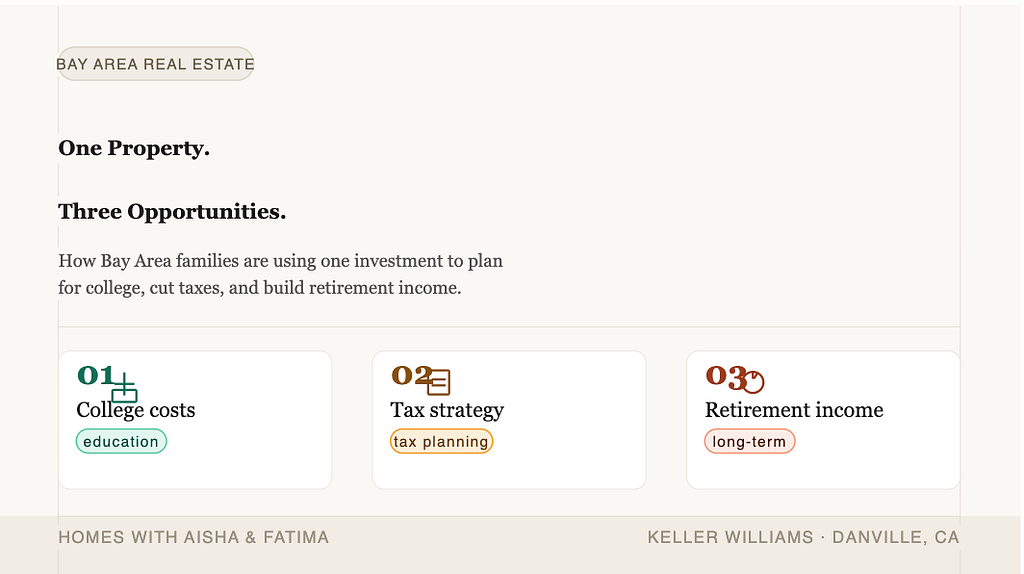
- Help offset college costs
- Create legal tax advantages
- Build flexible retirement income
Let’s look at each one honestly — including the parts that are often oversimplified.
Opportunity #1: Can a Rental Property Help With College Costs?
The short answer: Yes — but not overnight, and not automatically.
When parents think about college savings, they think 529 plans, custodial accounts, or simply saving whatever is left after monthly expenses. These are valid tools.
But for Bay Area families, saving for college from income alone can feel nearly impossible. The mortgage, groceries, childcare, activities — daily life in one of the most expensive regions in the world — consumes most of what comes in.
A rental property offers a different mechanism.
Instead of saving from income, you create income from an asset.
Here is a realistic example:
A family in Dublin or San Ramon purchases a small investment property while their child is still in elementary school. In year one, the returns may be modest. But over time:
- Monthly rent increases while the mortgage stays fixed
- The loan balance decreases as tenants effectively help pay it down
- Equity builds through appreciation and paydown
- The property becomes easier to cash flow
By the time the child is ready for college, that property creates options — not obligations.
The family may use the monthly cash flow to help cover tuition. They may access equity through a refinance if it makes sense. They may sell and apply the gain. Or they may keep the property producing income for years to come.
Some families call this a “scholarship house.” Not because the property magically covers tuition from day one. But because the purchase was made with education as part of the plan.
For Bay Area buyers: Strong cash flow is often hard to find in Danville, San Ramon, or the Peninsula. Many families explore more affordable markets — either nearby or out of state — where the purchase price allows better monthly returns. The property does not need to be around the corner. It needs to serve the goal.
Opportunity #2: Real Estate as a Tax Planning Tool
This is the part of real estate investing that does not get enough attention — and the part where a good CPA becomes essential.
Rental property owners may be eligible to deduct expenses including mortgage interest, property taxes, insurance, repairs, property management fees, and depreciation.
Depreciation is especially powerful because it allows you to claim a paper deduction on the property’s value over time — even while that property may be appreciating in the real world.
In simple terms: a property can go up in value while still generating a tax deduction.
This does not benefit every investor equally. It depends on your income level, how you classify your rental activity, passive activity rules, and how the property is structured. This is why working with a qualified CPA who understands real estate is not optional — it is essential.
But for higher-income Bay Area households — particularly those in the $300K–$700K+ household income range — real estate can become a meaningful part of a larger tax strategy:
- Reducing taxable rental income
- Potentially offsetting other income in certain qualifying situations
- Improving overall after-tax returns
- Creating additional deductions through cost segregation studies or short-term rental strategies (where applicable)
The key takeaway: Real estate is not only an income tool. For many Bay Area families, it is also a legal, smart tax planning tool — and that changes the math on whether a property “makes sense.”
Opportunity #3: Rental Income as Retirement Flexibility
Most Bay Area families are already contributing to 401(k)s and IRAs. Many still wonder if it will be enough.
Will Social Security cover what we need? Will accounts last 25–30 years? What about healthcare costs? What if we need to support aging parents?
A rental property creates a different kind of retirement asset — one that does not depend on market performance in the same way a stock portfolio does.
Over time, as the mortgage balance decreases and rents increase, the monthly cash flow from a property typically improves. By retirement, that same property that produced $200/month in year two may produce $900/month or more — with the loan nearly or fully paid off.
But more than the monthly income, it is the flexibility that matters most.
In retirement, that property gives you options:
- Keep it and collect monthly income
- Sell if your needs or goals change
- Use a cash-out refinance for a major expense
- 1031 exchange into a different property type
- Pass it to your children as a wealth-building foundation
This is where generational wealth actually begins — not with millions, but with one thoughtful decision made early enough to grow.
The Part That Must Be Said Clearly: Not Every Property Is a Good Investment
Real estate investing works best when it is planned, not rushed.
A beautiful home is not always a good rental. A popular neighborhood is not always a strong cash flow market. A low purchase price does not automatically mean a good deal. And a tax benefit will not save a fundamentally poor investment.
Before buying any investment property, Bay Area families should evaluate:
- Expected monthly rent (based on actual comparable rentals, not optimistic estimates)
- Total monthly carrying costs — mortgage, taxes, insurance, HOA if applicable
- Maintenance reserves (typically 1% of property value per year)
- Vacancy rate in that specific market
- Property management fees if you will not self-manage
- Short-term rental regulations if considering an Airbnb-style strategy
- Your realistic exit strategy at year 5, year 10, and year 20
For Bay Area investors especially, emotional decision-making is a real risk. The Bay Area mindset is built around appreciation — “buy it, it’ll go up.” That may be true. But investment property should be evaluated on cash flow, purpose, and downside risk — not hope alone.
The better question is never just: “Can we afford to buy it?”
It is: “Does this property support our family’s goals without quietly making our life harder?”
A good investment property should work in the background of your life — not add stress to it.
What This Could Look Like: A Real East Bay Family Scenario
Let’s make this concrete.
A family lives in the East Bay — Walnut Creek, Pleasanton, or Fremont. They own their home. They have two children, ages 7 and 10. They are comfortable financially, but college planning feels abstract and overwhelming. Retirement is on their radar but feels far away.
Buying a second investment property in their own backyard may not pencil out — prices are high and monthly cash flow is thin.
So they start exploring other options:
- A long-term rental in a more affordable inland city
- A short-term rental in a Central Valley or coastal vacation market
- A small condo or townhouse in a secondary market with stronger rental yields
They do not rush. They speak with a lender first. They speak with a CPA. They review real rental data — not Zillow estimates. They model three scenarios. They understand the risks.
Then they purchase a property with a clear written purpose: This property’s job is to help cover college costs in 8 years, reduce our tax burden annually, and generate retirement income in 20.
In year one, it is quiet. Stable. Not exciting.
But the tenant is helping pay down the loan. Equity is building. Tax deductions are improving the annual picture. And the family now has a future asset — one that can serve multiple goals.
That is the real power of this strategy.
Not hype. Not overnight wealth. Patience, structure, and purpose.
The Most Important Question to Ask Before Buying
Most people ask: “Should I buy an investment property?”
That is a reasonable question. But a better question is:
What specific job do I want this property to do for my family — and over what timeline?
Is its job to produce monthly income today? Help with college in 10 years? Reduce taxes this year? Build retirement income in 20 years? Create something to pass to your children?
Once you know the job, the property search becomes far more focused. You stop looking at “good deals” and start looking for the right fit for your plan.
The best investment property is not the one with the nicest kitchen or the lowest price. It is the one that genuinely fits your goal, your timeline, your risk tolerance, and your real family life.
Final Thought
For Bay Area families, real estate investing can feel out of reach — or like it is only for people with more capital, more time, or more knowledge than they have.
But smart investment strategy does not always mean buying the biggest or most expensive property. Sometimes it means buying the right property, in the right market, for the right reason — and having a clear plan for what you want it to do.
One property may not pay for everything.
But one well-chosen property, purchased with intention, can become part of your college plan, your tax strategy, your retirement income, and your family’s long-term wealth story.
That conversation is worth having.
Ready to Explore What Could Work for Your Family?
If you are curious whether an investment property could support your goals — for college, retirement, taxes, or long-term wealth — we would love to have a real, no-pressure conversation with you.
📅 Book a free 30-minute strategy call with Fatima or Aisha: https://calendly.com/homeswithaisha-fatima
Malick Fatima Noor and Aisha Naeem are Bay Area real estate professionals with Homes with Aisha & Fatima at Keller Williams, Danville, CA — helping families across the East Bay, Tri-Valley, and surrounding areas make thoughtful, informed decisions about buying, selling, and investing in real estate.
