
Inventory has nearly tripled since February. Buyers are more selective. Yet some homes are still selling fast and above list price. Here’s what the data actually means — and what it doesn’t.
By Malick Fatima Noor
Homes with Aisha & Fatima | Keller Williams Danville CA
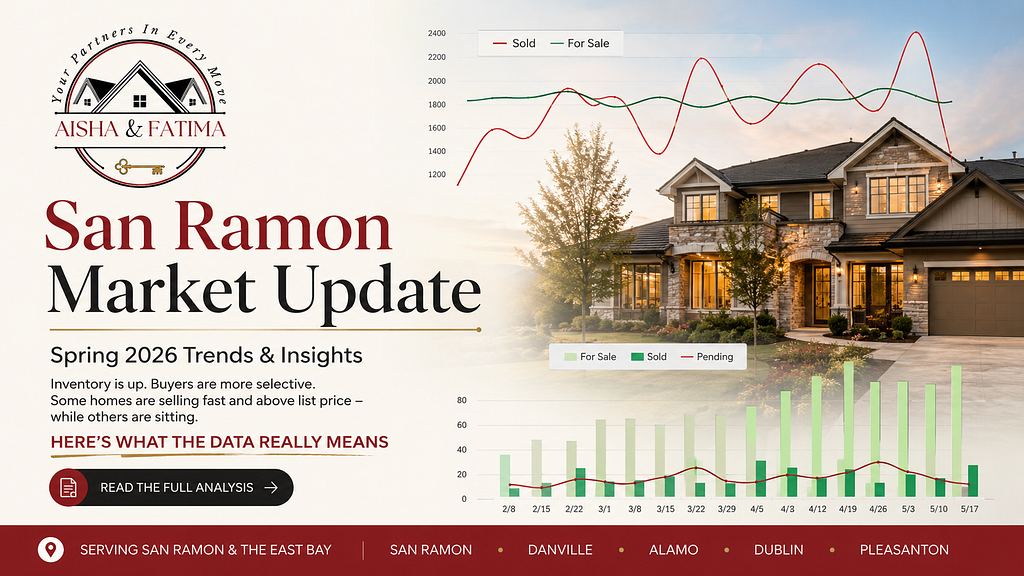
The two charts above explain a lot of the confusion people are feeling about today’s market.
Right now, depending on who you talk to in San Ramon, you will hear very different things about the housing market.
One homeowner says homes are still flying off the shelf. Another says their neighbor has been sitting on the market for six weeks. A buyer feels like they finally have breathing room. A seller feels uncertain whether to list now or wait.
They are all telling the truth.
And that is exactly what makes today’s market more complicated than the headlines suggest.
The San Ramon spring 2026 data does not tell one story. It tells two — and understanding both is what separates the buyers and sellers who move strategically from the ones who react emotionally.
What the Charts Actually Show
Let’s look closely at the numbers.
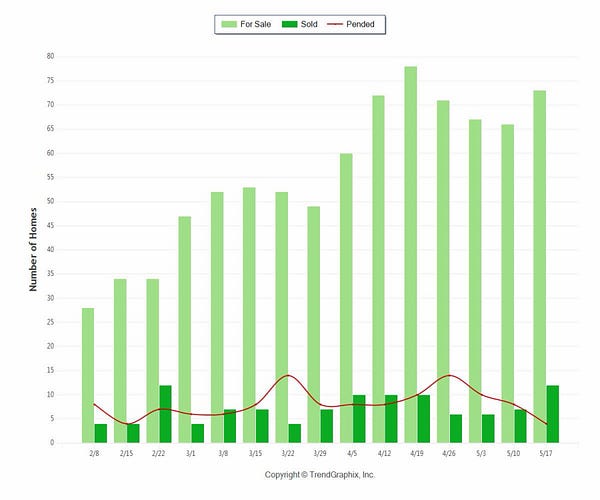
Chart 1 — Inventory vs. Activity
Active listings in San Ramon started the year at roughly 28 homes on February 8th. By April 19th, that number had nearly tripled to 78 active listings. As of May 17th, inventory remains elevated at around 73 homes for sale.
That is a meaningful increase in supply.
But here is what many people miss when they first see that number:
Pending activity and closed sales never collapsed.
Throughout this same February-to-May period, pending activity remained relatively steady, hovering between roughly 5 and 14 homes per week. Closed sales followed a similar pattern, ranging from approximately 4 to 12 homes sold weekly.
Demand did not disappear.
It became more selective.
Buyers today are no longer afraid of missing out on every home.
They are afraid of overpaying for the wrong one.
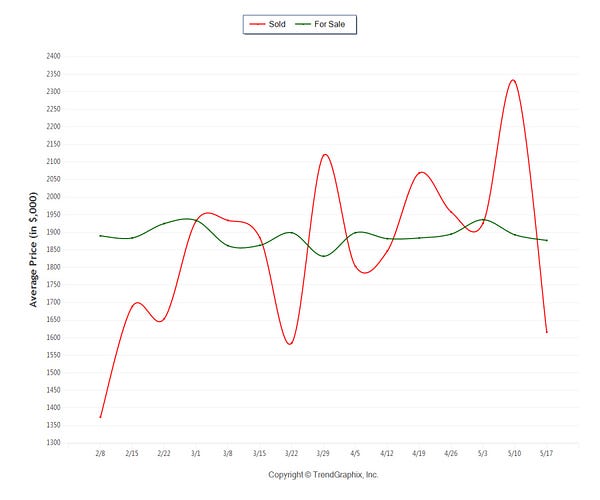
Chart 2 — Pricing Behavior
This chart is where the deeper story lives.
The green line — average prices for homes listed for sale — stayed remarkably stable throughout the spring market, ranging between approximately $1.85M and $1.95M.
Overall, sellers largely maintained confidence in pricing.
But the red line — average prices for homes that actually sold — tells a very different story.
Sold prices swung dramatically from week to week:
- Starting near $1.37M in early February,
- Climbing above $2.1M in late March,
- Dipping back near $1.58M around March 22nd,
- Peaking close to $2.33M in early May,
- then falling sharply toward $1.62M by May 17th.
That gap between relatively stable asking prices and highly volatile sold prices tells us something critically important:
Not every home is competing in the same market anymore.
What That Volatility Actually Means
The pricing swings are not random.
When sold prices spike significantly above the average asking price — as they did in late March and early May — it often reflects weeks where highly desirable homes closed strong:
- updated properties,
- strong school neighborhoods,
- excellent presentation,
- strategic pricing,
- and emotionally compelling homes that buyers felt confident stretching for.
When sold prices drop sharply — as they did in mid-March and again by mid-May — it usually reflects weeks dominated by:
- homes needing work,
- overpriced listings,
- properties sitting longer,
- negotiation-heavy transactions,
- or homes where buyers perceived uncertainty.
In other words:
The market is not moving uniformly upward or downward.
It is rewarding the right homes and penalizing the wrong strategy.
And that distinction matters enormously in today’s East Bay market.
Buyers Haven’t Left. They’ve Become More Careful.
One of the biggest misconceptions right now is that rising inventory automatically means a weak market.
The charts do not support that conclusion.
What rising inventory actually means is that buyers now have more choices — which naturally makes them more selective.
Mortgage rates continue shaping buyer psychology significantly in 2026.
As of late May, the average 30-year fixed mortgage rate remains around 6.53%, lower than last year but still far above the ultra-low rates buyers experienced during the pandemic years.
And when monthly payments feel heavier, buyers evaluate homes differently.
At roughly a $1.8M purchase price with 20% down, buyers today may face principal and interest payments approaching $9,000+ per month before taxes and insurance.
That changes behavior.
Today’s buyers are asking harder questions:
- Is this truly move-in ready?
- Will we inherit major renovation costs?
- Is the floor plan functional for daily life?
- Are the schools worth the premium?
- Has this home been sitting longer than expected?
- Can we justify this payment if rates stay elevated?
The homes answering those questions confidently are still generating strong competition.
The homes leaving uncertainty are sitting longer — and eventually negotiating.
This is why buyers today are not paying premiums for possibility.
They are paying premiums for confidence.
The Seller’s Real Challenge Right Now
More inventory means sellers now face significantly more competition than they did earlier this year.
In February, buyers were choosing among roughly 28 active listings.
Today, they are choosing among more than 70.
That changes buyer behavior dramatically.
Because patience is the enemy of overpriced listings.
The first two weeks of a listing matter more than many sellers realize.
That is when:
- the most serious buyers are watching,
- agents review new inventory immediately,
- and buyers compare your home against everything else currently available.
If pricing feels disconnected from perceived value — even slightly — buyers often move on quickly to another option.
Then the listing sits.
Then the questions begin:
“Why hasn’t it sold?”
Then comes the reduction.
And many sellers eventually accept less than they might have achieved with a stronger launch strategy from the beginning.
The data suggests something very clearly:
Preparation and pricing strategy matter more today than market momentum.
The homes performing best in today’s San Ramon market are usually:
- Thoughtfully staged,
- Professionally marketed,
- Realistically priced,
- Emotionally easy for buyers to say yes to.
This market is not punishing sellers.
It is punishing overconfidence.
And there is an important difference between those two things.
The Buyer’s Real Opportunity Right Now
For buyers, this market is more nuanced than:
“It’s finally a buyer’s market.”
Yes, inventory has increased.
Yes, some sellers are negotiable.
And yes, buyers today may realistically negotiate:
- Credits,
- Repairs,
- Pricing adjustments,
- Stronger terms
— especially on homes that have been sitting longer or entered the market too aggressively.
But the charts also show that the strongest homes are still closing extremely well.
Those spikes in sold prices are not accidents.
They reflect what happens when a well-prepared home, in a strong neighborhood, with strategic pricing, meets a motivated buyer pool waiting for the right opportunity.
The smartest buyer strategy today is not:
“Offer low on everything.”
It is understanding the difference between:
homes that deserve urgency, and homes where negotiation leverage actually exists.
That distinction is often worth far more than broad national headlines.
San Ramon Remains a Strong Market — But No Longer a Forgiving One
Despite the complexity, San Ramon remains one of the East Bay’s strongest long-term markets.
School quality, planned communities, safety, commute access to Bishop Ranch and Silicon Valley, parks, and overall lifestyle desirability continue attracting serious buyers willing to pay meaningful premiums.
The market is not broken.
It has matured.
And mature markets behave differently.
In a mature market buyers become analytical, sellers must become strategic, and success depends less on momentum and more on execution.
For sellers, preparation is no longer optional.
For buyers, local expertise is no longer a luxury.
It is how you avoid overpaying for hype, missing real opportunities, or misunderstanding where leverage actually exists.
These charts tell a story that most national headlines cannot capture.
San Ramon’s spring 2026 market is active, competitive, and full of opportunity — but it is splitting in real time between homes that create confidence and homes that create hesitation.
And the gap between those outcomes is rarely luck. It is strategy. It is preparation. It is pricing.
It is understanding exactly where your property fits within today’s market psychology.
The East Bay market is no longer rewarding every listing equally.
It is rewarding clarity.
And in today’s selective market, clarity matters more than ever.
Want to Understand Where You Stand in Today’s Market?
Whether you are thinking about selling, buying, investing, or simply trying to understand how these market shifts affect your neighborhood, we would be happy to walk through the data and strategy with you.
No pressure. Just clarity.
📅 Book a free strategy conversation:
Malick Fatima Noor and Aisha Naeem are Bay Area real estate professionals with Homes with Aisha & Fatima at Keller Williams Danville CA, helping buyers, sellers, and investors navigate the East Bay market with thoughtful strategy, local insight, and long-term perspective.
